Thursday, 11 December 2014

The 1940s Picture Post and the story of the Home Front in WWII

The story of the Home Front during World War Two was about how to turn a democratic and freedom loving people into a formidable war machine! A booklet, published by the Ministry of Labour in 1944, describes the mobilisation of the British people and how the nation was prepared for war.

Legislation was passed to ensure that the nation's workforce was available for the war effort, and the Trade Unions co-operated. Some people were required to leave their jobs and retrain. Skilled workers considered absolutely necessary for the war effort became reserved occupation. The governments compulsory powers extended to rich and poor alike.

 For example, hundreds of young women left their homes and families in Scotland, travelling to stay in hostels in Birmingham and work in the factories. Tanks, guns, aircraft and munitions were needed and the nation's women volunteered. The miners, dockers and railway workers and the Merchant Navy were now also considered to be essential to the war effort and food production had to be increased.

In 1940, during a hot summer, determined factory engineers worked themselves to a standstill. This was considered to be not good at all, either for health or productivity, so more planning was introduced. Despite this, many full-time workers also became part-time air raid wardens and fire wardens or helped in other ways. Everyone contributed to the war effort, by doing whatever they could.

Britain also had to ensure it could defend itself against the threat of invasion and that despite continual air raids that essential services and basic living standards were maintained.

Motivating speeches were supplied by the nation's leaders via radio and the press, and The Picture Post published moving pictures of ordinary people at war.

The mobilisation of the nation required a  phenomenal effort. Even our allies thought it couldn't be done. WWII had demanded and received an extraordinary response from the British people.  "We could never have survived at all if we had not mobilised our manpower......if the people had not been willing."

Source:  Manpower - The Story of Britain's Mobilisation For War
Prepared for the Ministry of Labour and National Service by the Ministry of Information. (First published 1944)

The Picture Post Album by Robert Kee

Wednesday, 3 December 2014

1940s PICTURE POST AT THE SEVERN VALLEY RAILWAY


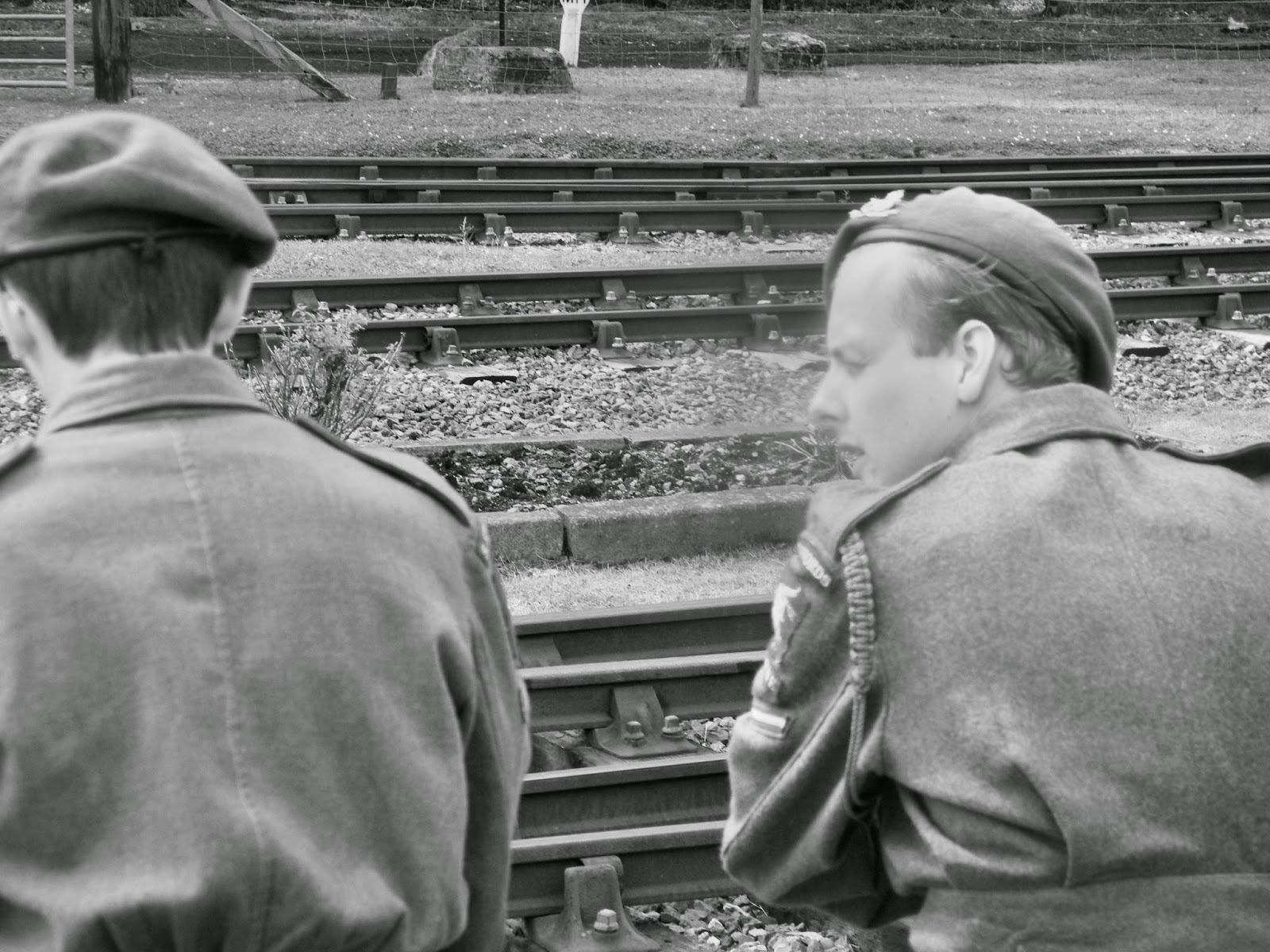
There's something special about a visit to the Severn Valley Steam Railway! The sights and sounds we experience allow us to travel back in time to the 1940's. It is now how it was then.  Add the re-enactors and the past is re-created and re-visited.

Attracting tourists from all over the world the Severn Valley Railway is also a highly popular venue for 1940s re-enactments. Usually their WWII Weekends feature vintage military vehicles, plenty of music and entertainment, battle re-enactments, re-enactors in civilian dress and uniform, exhibitions and displays at every station and flypast from a World War II spitfire!

Shoppers can enjoy plenty of bargains on sale at the many stalls and there's also vintage clothes, shoes, hats and lots of memorabilia and bric a brac.

During WWII the trains carried troops, military vehicles, resources and weapons across the country and evacuees away from the cities, providing ambulance and armoured support alongside the track. Often a frequent target of enemy attacks, the railways and their workers played a vital role in WWII.


Thursday, 27 November 2014

CHURCHILL's SECRET ARMY - THE BRITISH RESISTANCE WWII


Churchill's hidden army was kept top secret.  The existence of the British Resistance and Auxillary Units and also the Special Duties Section remained covert until the 1990's. Then, a book and a film by Owen Sheers revealed the contingency proposals for Britain's secret army.

 In 1940 following Dunkirk and the occupation of Europe, plans for the British Resistance Organisation to defend the Homefront were put into action. Underground Operational Bases were created and patrols were trained in combat, intelligence and the use of weapons and sabotage. 

 Little is still known about Britain's Resistance and mostly the families were never informed. In occupied Britain the life expectancy of the members of the Resistance would have been only two weeks!

However, more details have emerged about the underground soldiers and spies in Wales. In September 2014 at Bantock House Museum in Wolverhampton, there was an exhibition about the work of the Resistance in Wales displaying the type of weaponry   issued to "The Scallywags" or GHQ Auxillary Units. These were to be used in the event of the invasion of Britain.

This is a fascinating and little known story and if you want to know more about The British Resistance and the Auxillary Units you can visit the www.auxunit.org.uk  Other links include www.coleshillhouse.com and www.abergavennymuseum.co.uk


Friday, 21 November 2014

A Grand Tea Dance

We all stepped back in time at this costumed WWII themed event! The Grand Tea Dance was the venue for Susan's 65th birthday party and the location was Aston Wood Golf Club, Little Aston in the West Midlands.

 There was Hollywood glamour and top hats and white ties, with some officers wearing their dress uniforms and of course the Homefront and the Army, Navy and Air Force were also represented. Wartime rations were provided for us and there was lots of music and dancing 1940's style. Holly Hewitt sang for us and sparkled in a beautiful red sequinned dress and later everyone joined in a jolly community sing song.

The re-enactors set the scene making us feel we had travelled back in time  to 1939. We all listened to speeches from Field Marshall Montgomery and Prime Minister Winston Churchill who both recreated the mood of the time.  Fire wardens were on hand to ensure everyone survived a dramatic "air raid" and the noise of the Blitz, and the drama continued with the arrest, by the Home Guard, of a spiv trying to peddle black market goods to the guests!

The Grand Tea Dance was an enjoyable and entertaining event and as the guests and re-enactors left I heard someone say,"can't we do this again next year?" Exactly! Thank you Susan.    

Wednesday, 12 November 2014

WWII Day at Jones of Shropshire


Visitors to the first World War Two themed event by Jones of Shropshire, Bridgenorth, enjoyed hot chocolate and homemade brownies while watching "The Dam Busters" in "The Mess" and other vintage film.
 
This Aladdin's cave of antique and vintage goodies re-created the atmosphere of the 1940's with costumes and music and a raffle raising funds for Help for Heroes. Hand knitted poppies were also on on sale to support the Royal British Legion. 

 Visiting re-enactors and enthusiastic members of the public helped to make this day a fun and memorable occasion. You can find Jones of Shropshire at Rudge Heath Nurseries, Bridgnorth Road WV6 7EE, they're also on Facebook and there are more photo's on the Jones of Shropshire page.

Saturday, 8 November 2014

Remembrance Day 2014

"At the going down of the sun,
 and in the morning, we shall remember them."


Tuesday, 4 November 2014

Churchill, Bletchley Park, the Radio Spies and "The Imitation Game"

Churchill's experiences during World War One had prepared him for the national web of secrecy and espionage needed to help defeat Hitler in World War Two.  This included Bletchley Park and it's famous code breakers. Also, the radio interceptors or radio spies who were based at listening stations throughout Britain, listening and writing down enemy morse code transmissions which were sent to Bletchley Park for decoding. Further support came from the Voluntary Interceptors, who were recruited early in the war, radio hams with the expertise and often their own radio equipment needed to listen in to enemy transmissions.  They also worked in secret, often from their own homes, the other occupants of the house unaware of their activities.

"The Imitation Game," a new film starring Benedict Cumberbatch is a bio-pic of the work of the mathematician Alan Turing at Bletchley Park, decoding the information from the radio interceptors and working with colleagues to develop the "Bombe" an early computer to assist with and speed up the process of code-breaking. The success of Bletchley Park saved over three million lives and helped to shorten the war. The  work and accuracy of the Y Service or listening station was also vital. For example, a listening station at the Old Rectory, Whitchurch, Shropshire intercepted foreign diplomatic transmissions from the Japanese Embassy in Berlin to Japan, giving detailed information about German defences in northern France in 1943. helping with the success of D-Day. The importance of safeguarding "Ultra" the intelligence received from Bletchley Park and of keeping Germany unaware of our ability to break the Enigma code is well known, but Churchill's vast network of secrecy also extended to the homefront with the British people's contribution, well aware that "careless talk costs lives."